The opening experiment
The first guests were test guests.
The inaugural series was given during the unofficial opening of the Vallico Academy. The audience was small, residential and captive in the best possible sense: the talks could continue over dinner, on the terrace and along the mountain paths.
The subjects were deliberately chosen to look unrelated. The connection was withheld until the end. Rather than presenting a doctrine, the series asked the audience to notice the same problem appearing in biography, philosophy, physics, theories of consciousness and neuroscience.
It was also a test of the Academy itself: whether a place like Vallico can make room for sustained arguments that would be awkward to fit inside a normal seminar programme.
The route
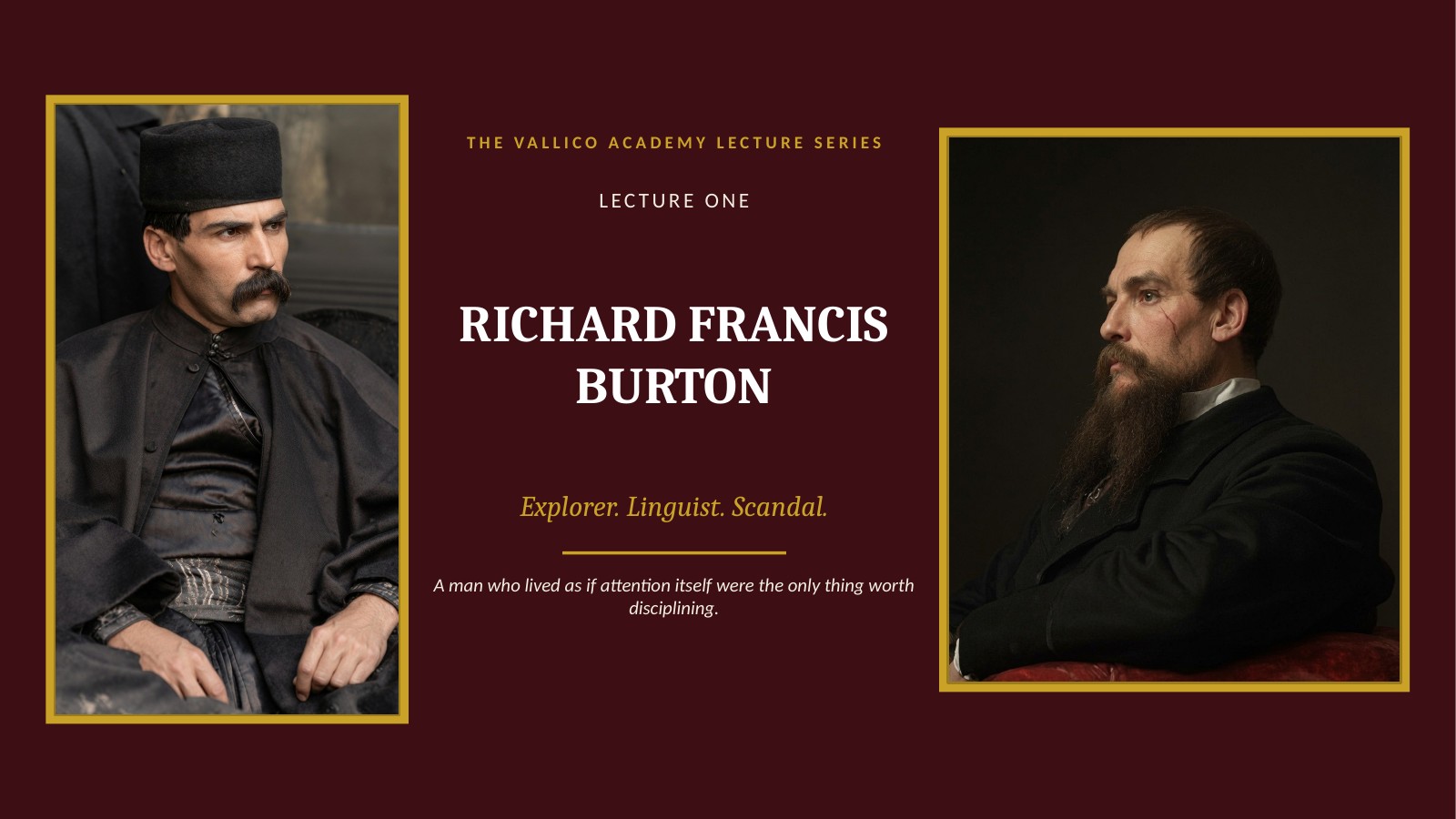
Lecture I
Richard Francis Burton
Explorer. Linguist. Scandal.
A man who lived as if attention itself were the only thing worth disciplining.
Burton opens the series through a life rather than a theory: explorer, soldier, translator, ethnographer, linguist and professional transgressor of boundaries. The lecture asks what kind of attention allows one person to enter so many different worlds without reducing them to a single familiar map.
The thread: curiosity before specialisation; direct encounter before abstraction.
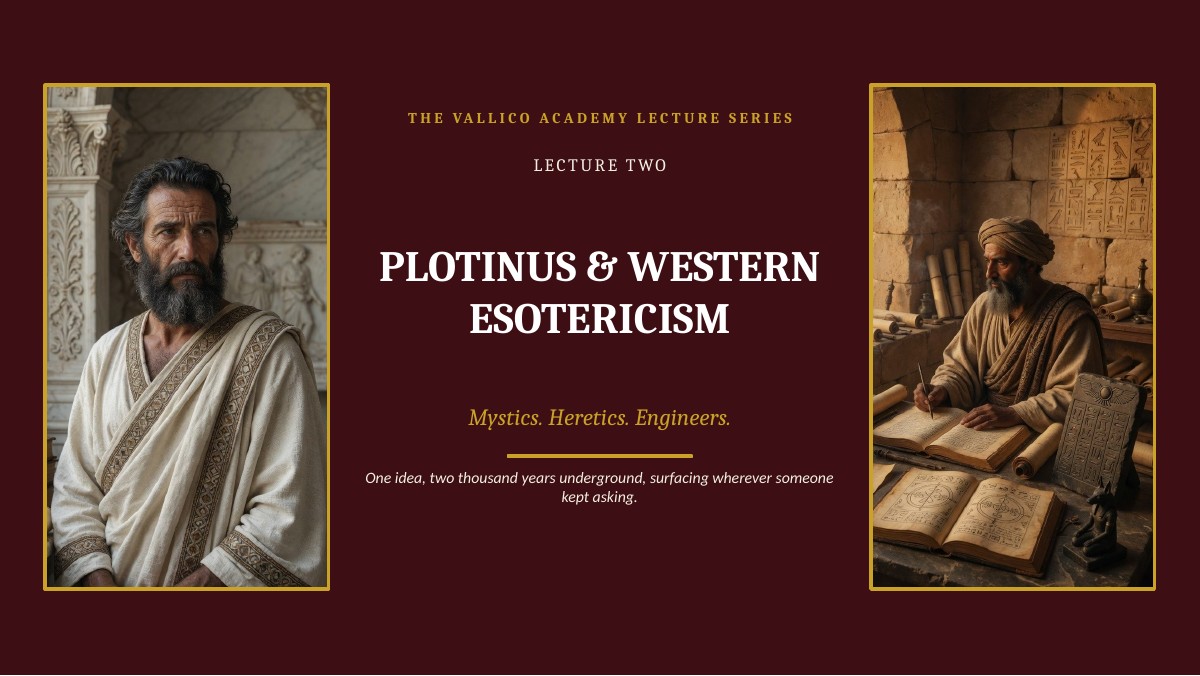
Lecture II
Plotinus & Western Esotericism
Mystics. Heretics. Engineers.
One idea, two thousand years underground, surfacing wherever someone kept asking.
Plotinus provides the starting point for a journey through traditions that official intellectual histories have repeatedly marginalised, absorbed or suppressed. The aim is neither belief nor debunking, but to ask why certain pictures of the world keep returning.
The thread: take rejected ideas seriously enough to understand them, without surrendering the right to call them wrong.
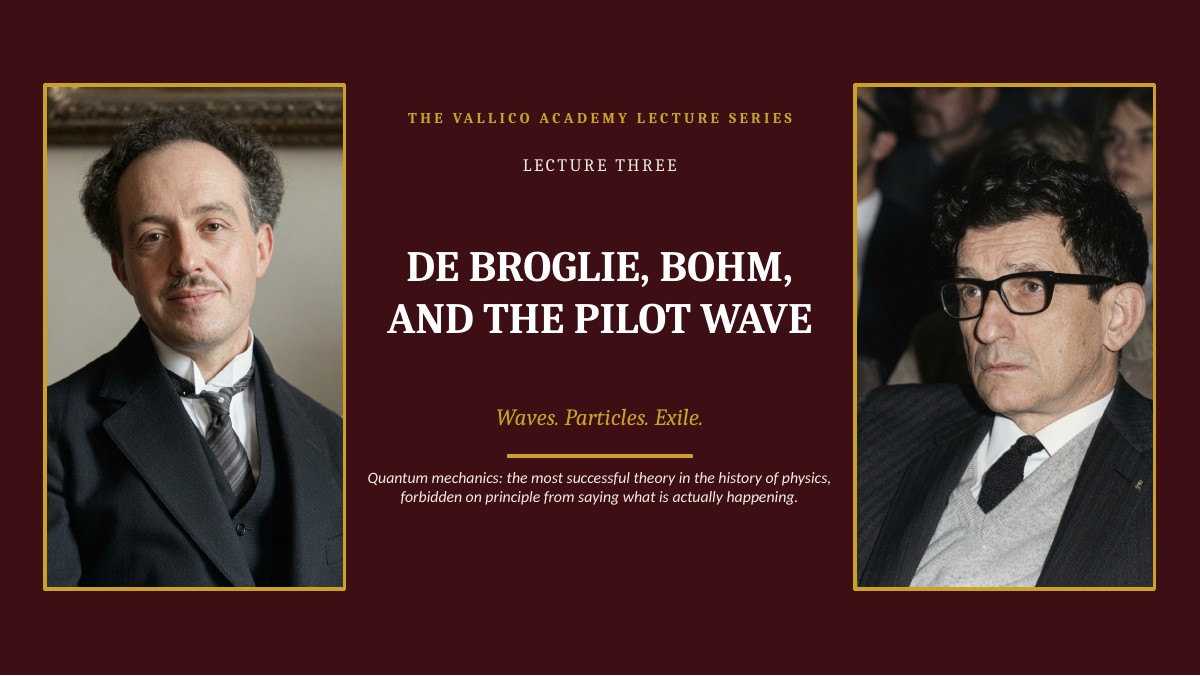
Lecture III
De Broglie, Bohm, and the Pilot Wave
Waves. Particles. Exile.
Quantum mechanics: the most successful theory in the history of physics, forbidden on principle from saying what is actually happening.
The third lecture turns to quantum foundations and the history of pilot-wave theory: from de Broglie's proposal to Bohm's revival of a realist account in which particles have definite positions and are guided by a wave. It treats the physics seriously while also asking why some questions become intellectually unfashionable.
The thread: when a formalism predicts perfectly, are we still allowed to ask what the world is doing?
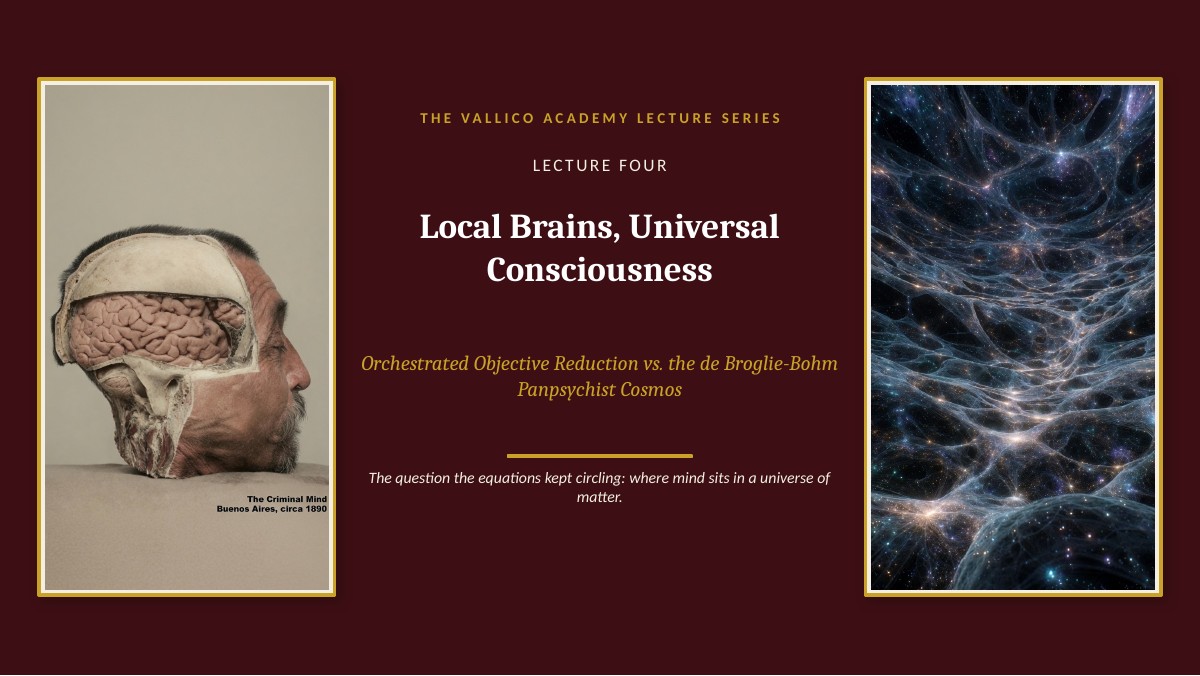
Lecture IV · explicitly speculative
Local Brains, Universal Consciousness
Orchestrated Objective Reduction vs. the de Broglie-Bohm Panpsychist Cosmos
The question the equations kept circling: where mind sits in a universe of matter.
Here the series deliberately leaves established ground. Penrose and Hameroff's Orch-OR is set beside a speculative panpsychist or cosmopsychist reading of de Broglie-Bohm ideas, including the lecturer's own proposals.
The distinction matters: this lecture is an argument to interrogate, not an Academy position to accept. Objections are part of the presentation rather than an embarrassment to be hidden afterwards.
The thread: speculation is useful when its status is made explicit and its weak points are exposed.
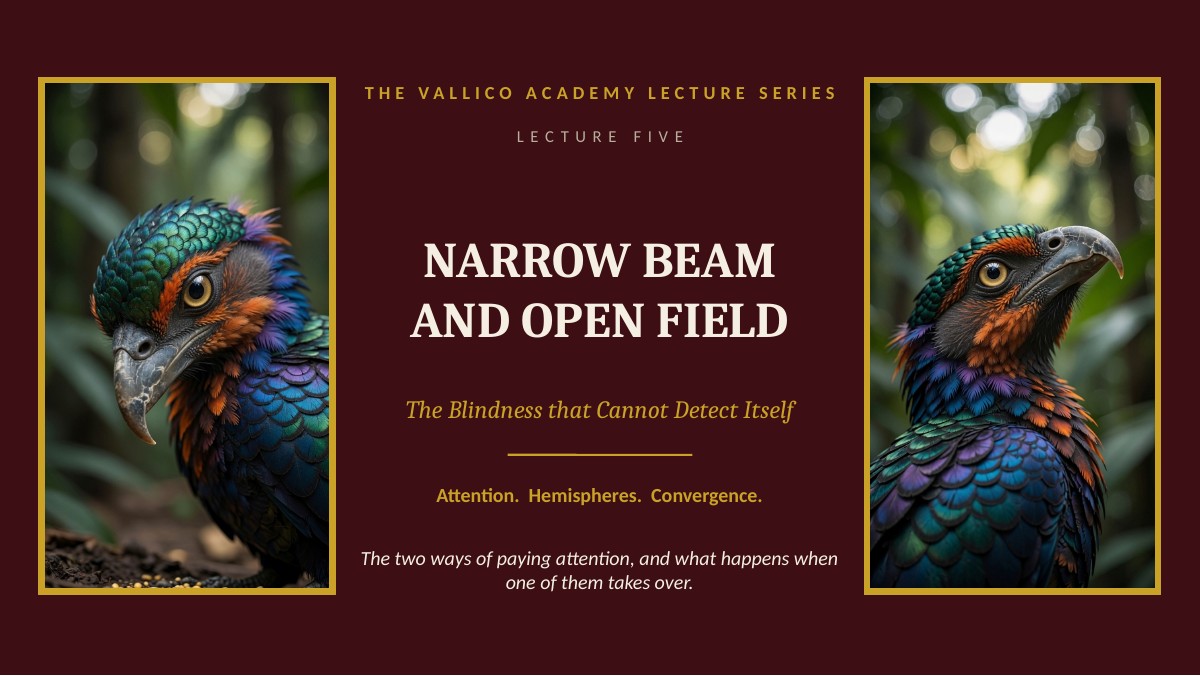
Lecture V
Narrow Beam and Open Field
The Blindness that Cannot Detect Itself
Attention. Hemispheres. Convergence. The two ways of paying attention, and what happens when one of them takes over.
The final lecture brings the previous four together through Iain McGilchrist's account of two different modes of attention: one narrow, grasping and useful; the other broad, contextual and open to relationship and the living whole.
The idea is not installed as Academy dogma. Instead it becomes a practical question: can a place be arranged so that walking, conversation, physical work, books, landscape and unhurried time make the broader mode easier to recover?
The thread revealed: how we attend may determine what kind of world we are capable of seeing.
How the series works
Serious without becoming solemn.
History is not hagiography. Characters can be extraordinary, wrong, objectionable and fascinating at the same time.
Rejected ideas are not automatically profound. They are examined because some deserve examination, not because marginality proves truth.
Physics remains physics. Evidence, established theory, interpretation and personal speculation should not be allowed to blur into one another.
Humour is permitted. So are staged arguments, audience participation, callbacks and changing one's mind in public.
Series I archive
The lectures are only the beginning of the record.
The complete slide decks and speaker scripts are now available with each lecture. References, photographs and related material will be added here as the Academy archive develops. Future lecture series will sit alongside the first rather than replacing it.