These films are calculations made with CASINO. The pictures of particles are
drawn from the positions the calculations computed; the family tree is drawn
from the record of which walkers a calculation copied and removed. Most show diffusion Monte
Carlo, in which a population of walkers, each one copy of the positions of
all the particles, is carried by a random walk in imaginary time towards the
state of lowest energy; that walk is how the calculation finds the state, not
the motion of the particles. The last film shows something else: electrons
moved in real time along de Broglie–Bohm trajectories. Two of the
calculations can also be turned and played in the browser.
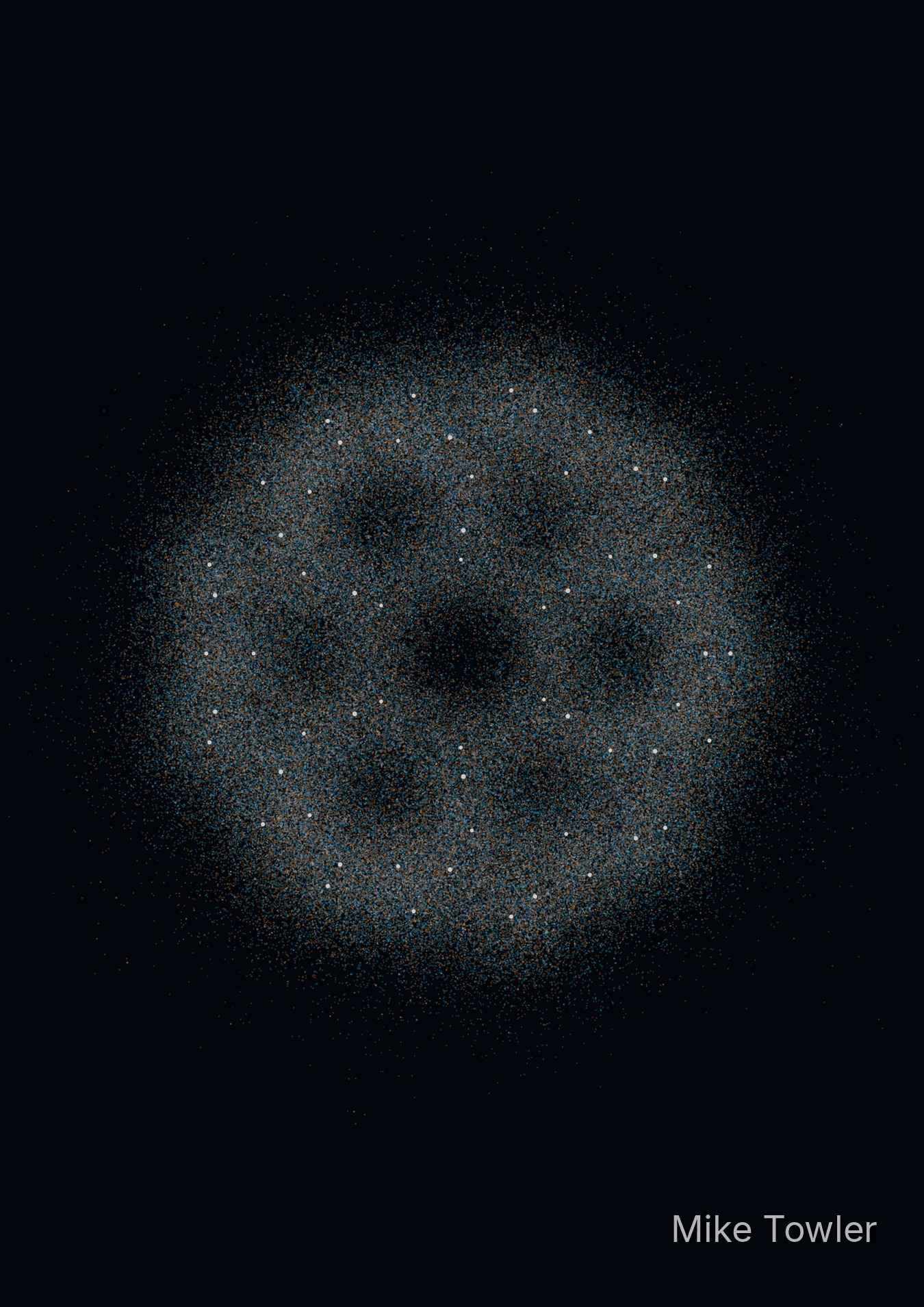
The living electron cloud: caffeine
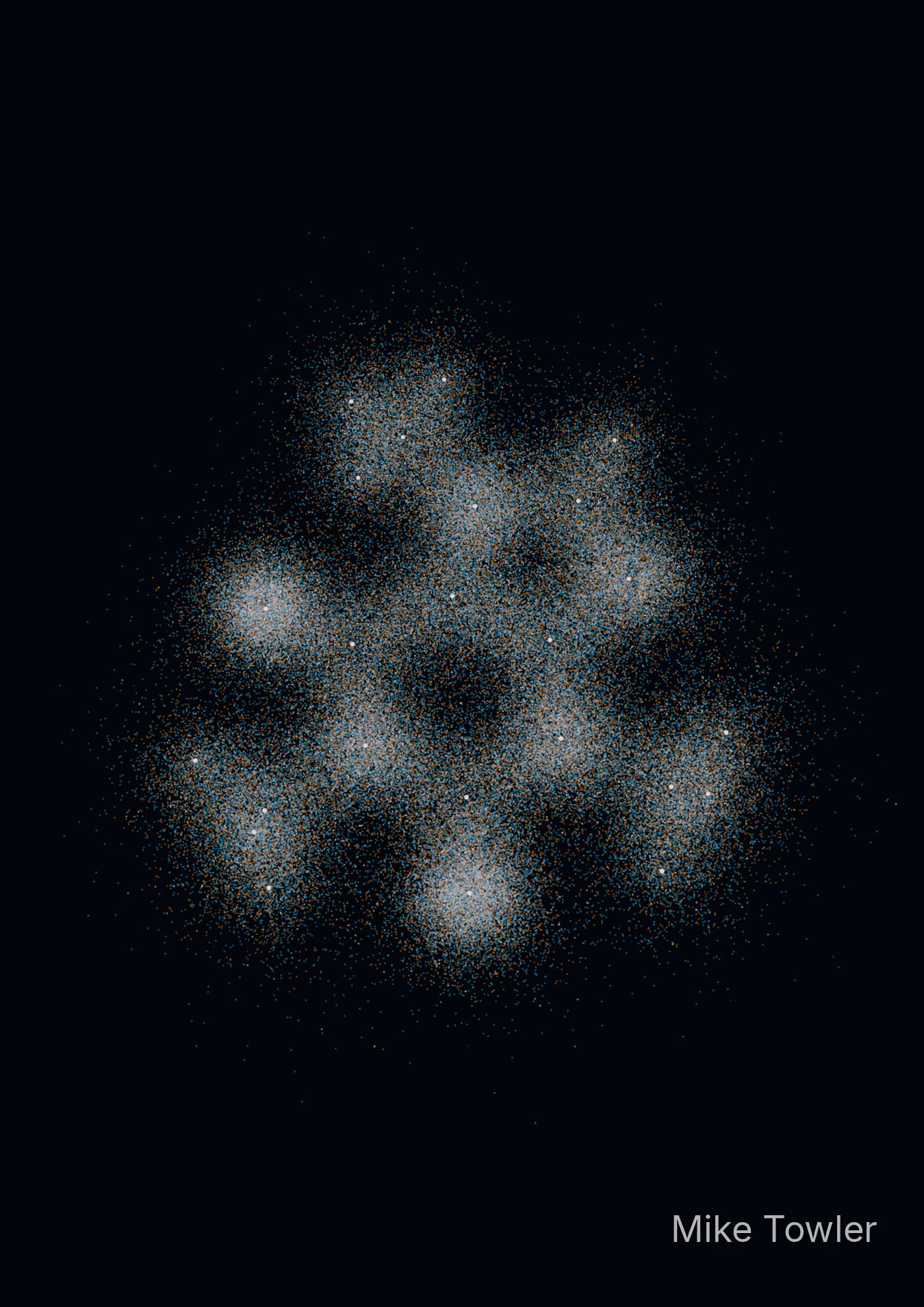
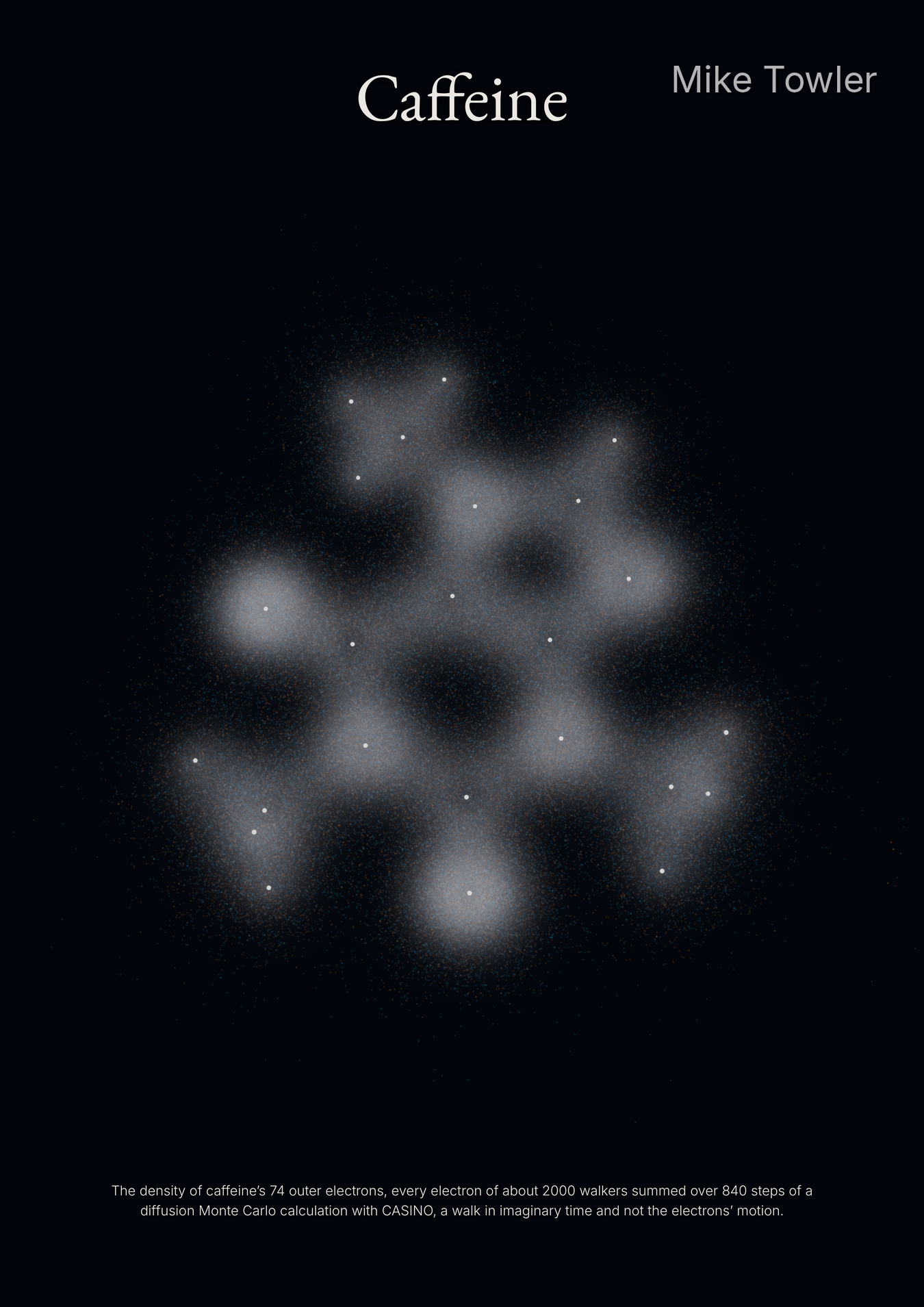
Caffeine’s 74 outer electrons as a diffusion Monte Carlo calculation
with CASINO v3.1.1134 found them on 20 October 2026, every coloured point a
computed position, from 128 preparatory random walks to about 2000 walkers,
a copy drawn as a brief flare and a removal as a fade, ending in a long
exposure of 840 steps that builds up the density of the outer electrons;
what moves is the calculation’s random walk, which runs in imaginary
time to find the molecule’s state of lowest energy, not the electrons.
Film by Mike Towler.
One step of the walk,
every electron of about 2000 walkers; and
the poster,
the long exposure: the density of the outer electrons summed over 840 steps;
the walk runs in imaginary time and is not the electrons’ motion. The same calculation’s walkers can be turned in the browser, below.
The walkers’ family tree
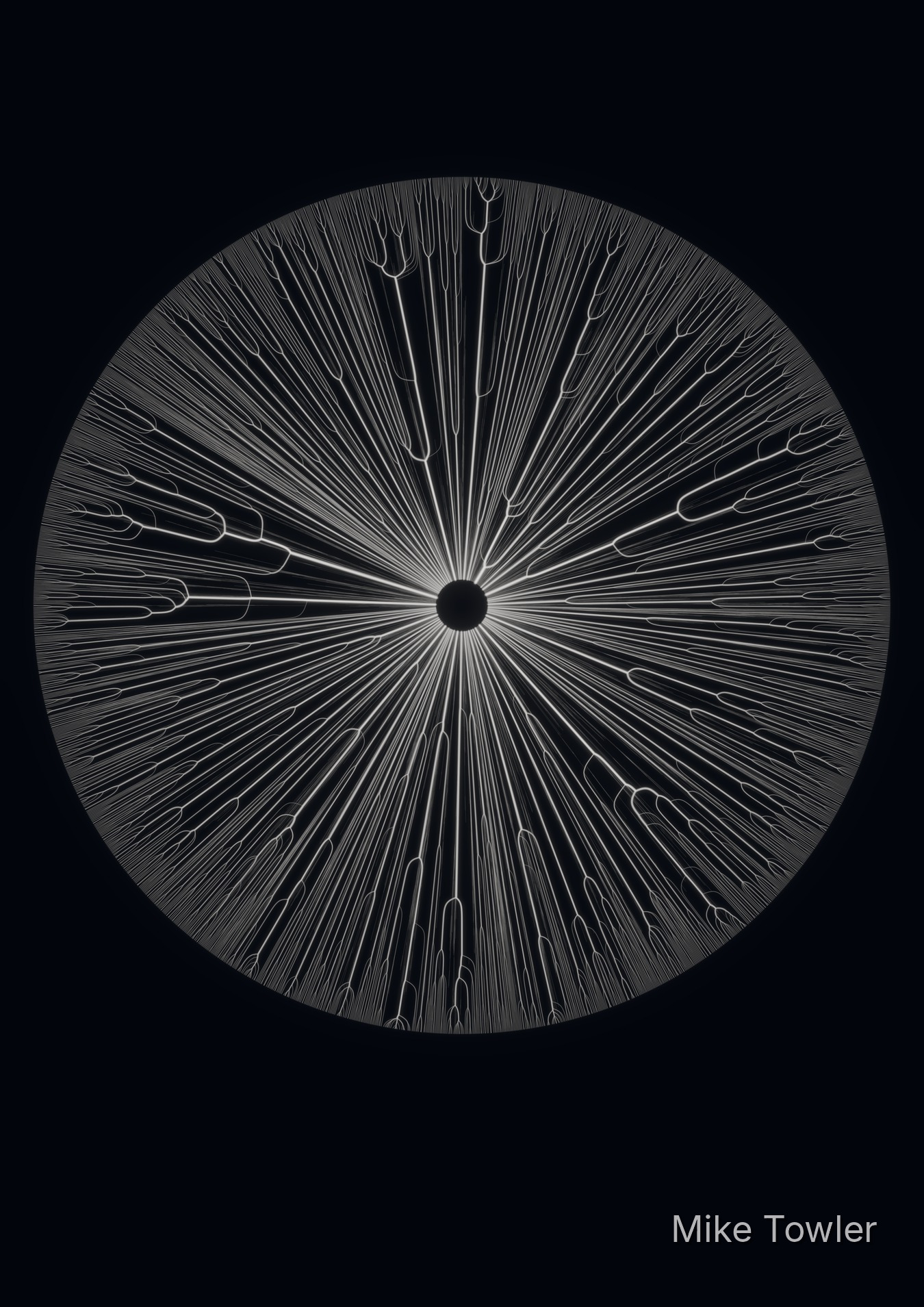
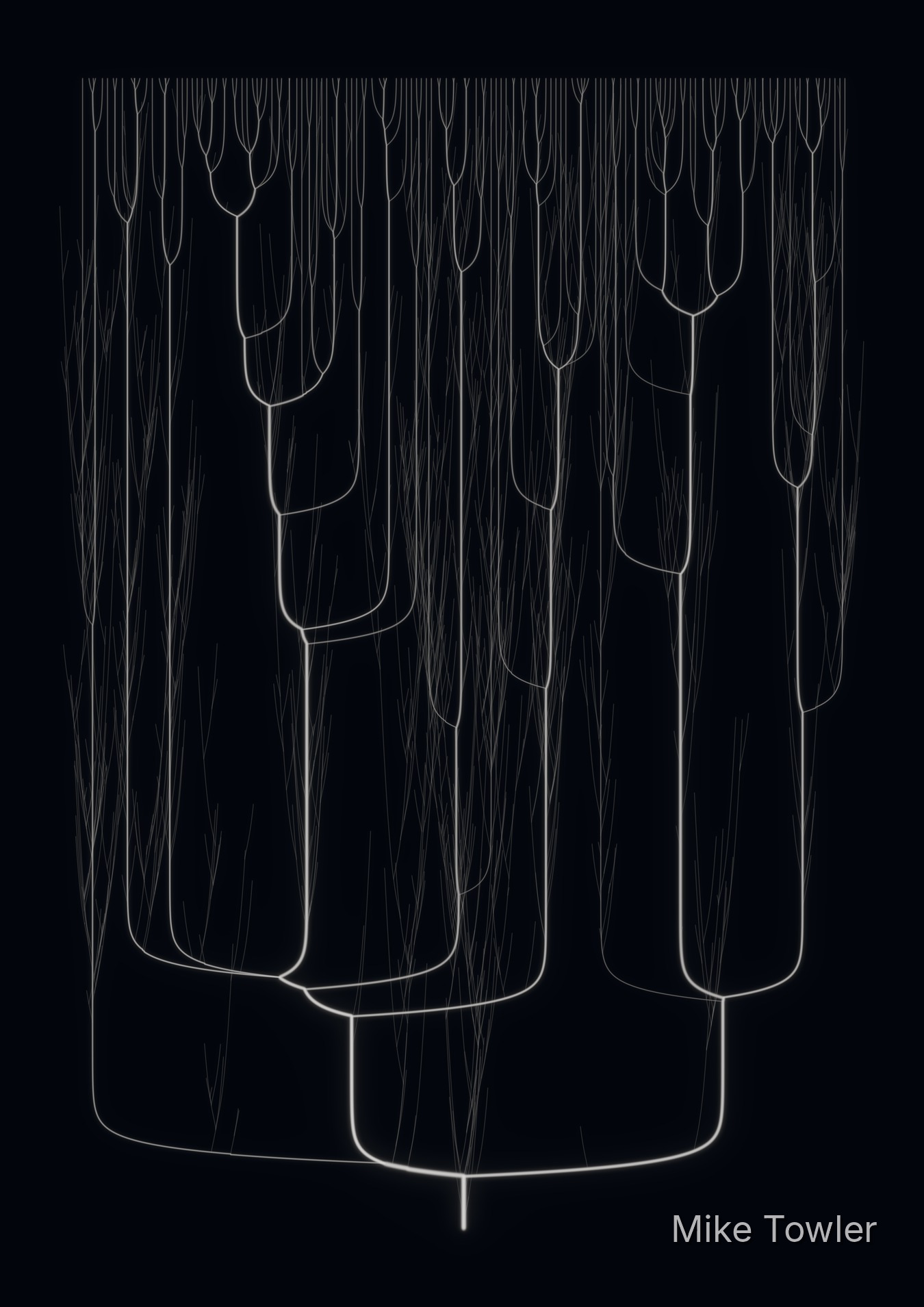
Every one of the 2072 walkers alive at the last of 2000 steps of a
diffusion Monte Carlo calculation of caffeine with CASINO v3.1.1134 on 20
October 2026, each walker one set of positions for all 74 outer electrons,
traced back through the calculation’s copies to the 89 of the 2000
starting walkers from which all of them descend, the branches with no
descendant at the last step drawn faintly; the tree records copying and
removal in imaginary time, the calculation’s way of finding the
molecule’s state of lowest energy, and nothing the electrons do.
Film by Mike Towler.
The whole tree,
the first step at the centre and the last at the rim; and
one family,
the 154 walkers alive at the last step that descend from one walker of the
first; the tree records copying and removal in the calculation’s walk in
imaginary time, not anything the electrons do.
C60
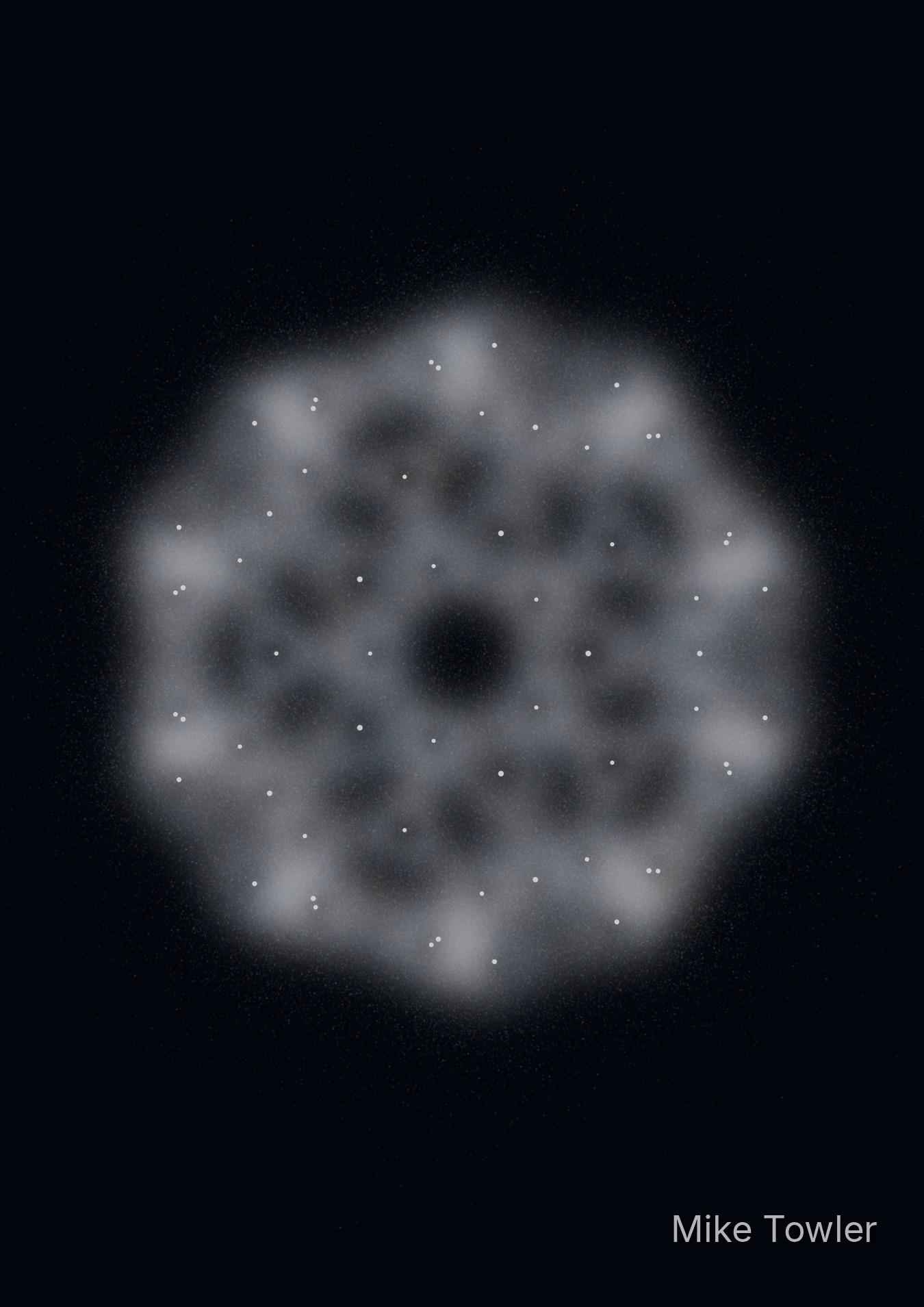
The 240 outer electrons of C60, sixty carbon atoms in the shape
of a football, as a diffusion Monte Carlo calculation with CASINO v3.1.1157
found them on 21 October 2026, every coloured point a computed position,
from 128 preparatory random walks that settle from a random start to about
1000 walkers, a copy drawn as a brief flare and a removal as a fade, ending
in a long exposure of 840 steps that builds up the density of the outer
electrons into a cage, seen along a fivefold and then a threefold axis;
what moves is the calculation’s random walk, which runs in imaginary
time to find the molecule’s state of lowest energy, not the electrons.
Film by Mike Towler.
The long exposure,
every electron of every walker summed over 1800 steps, seen through a
pentagon; and
one step of the walk,
1000 walkers seen through a hexagon; the walk runs in imaginary time and is
not the electrons’ motion.
Quantum nuclei
Four small molecules in which the nuclei, too, are treated as quantum
particles (the hydrogen molecular ion, the hydrogen molecule with heavy
hydrogen beside it, and the muonic molecular ion, two protons bound by a
negative muon), as diffusion Monte Carlo calculations with CASINO v3.1.1188
found them on 22 October 2026, after 512 preparatory random walks that
spread the hydrogen molecular ion’s protons from one line over a
shell: every point a computed position of a nucleus, an electron or the
muon, in 20,000 walkers for each molecule (a walker is a copy of the
positions of all its particles), each drawn about its own centre of mass
and then turned so that its two nuclei lie on one line, a drawing
convention, and each molecule at its own scale; neither the preparatory
walks nor the diffusion Monte Carlo walk, which runs in imaginary time as a
way of finding each molecule’s state of lowest energy, is the
particles’ motion.
Film by Mike Towler.
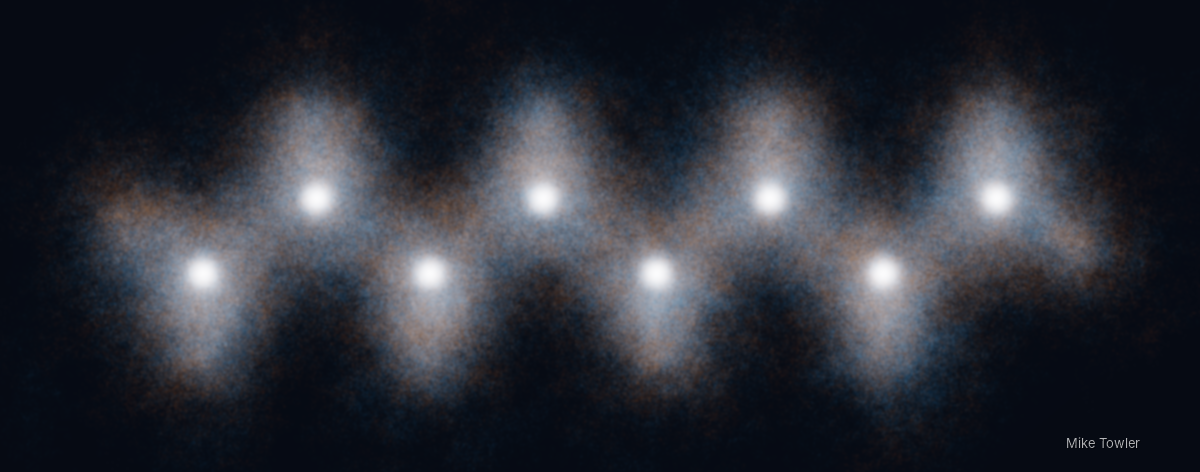
Two stills from the same calculations:
the hydrogen molecular ion,
each walker about its own centre of mass, the protons on a shell; and
the hydrogen molecule,
each walker turned so that its protons lie on one line; the walks run in
imaginary time and are not the particles’ motion.
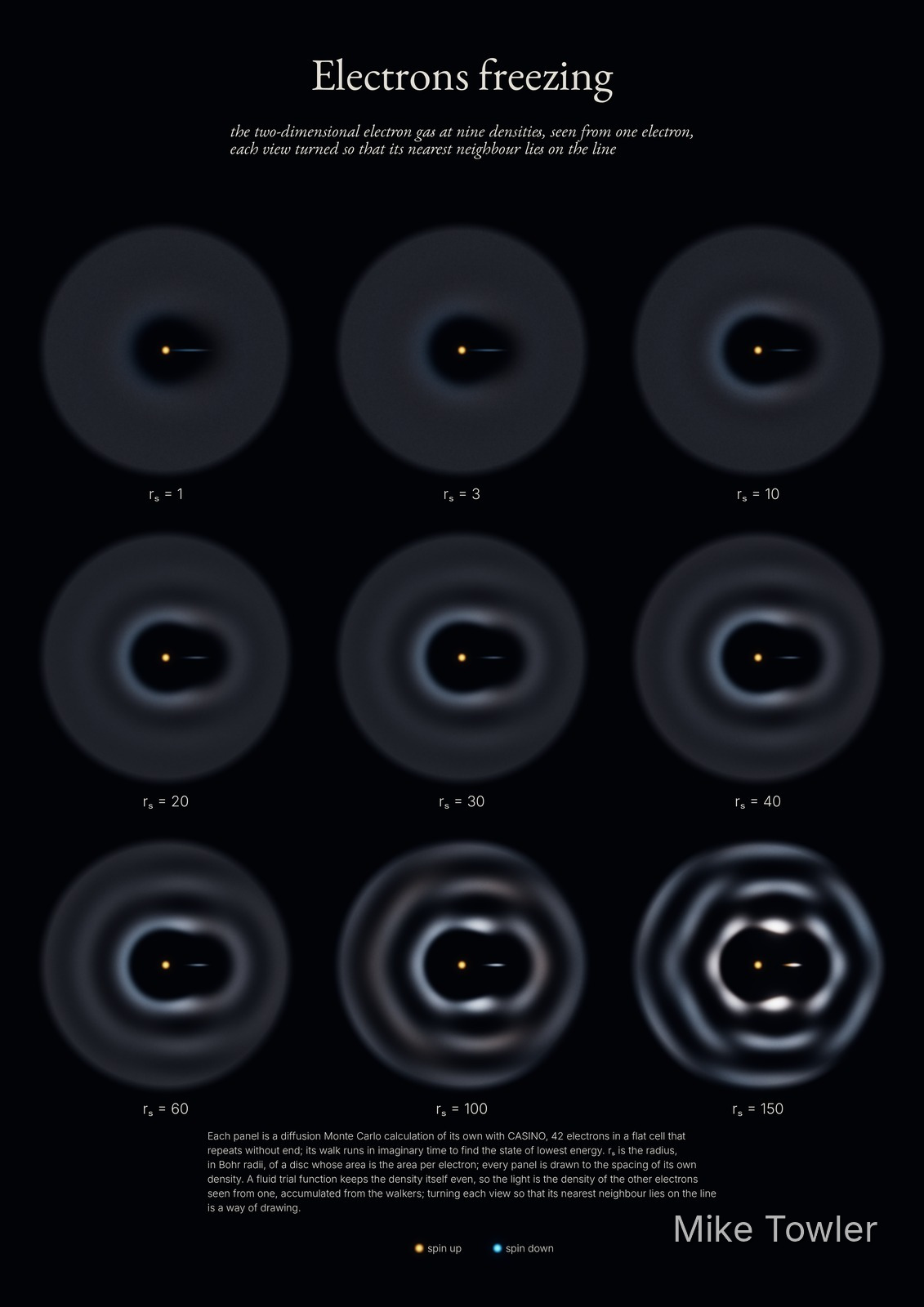
Electrons freezing
Forty-two electrons in a flat cell that repeats without end, computed with
CASINO v3.1.1188 on 22 October 2026 at nine densities from
rs = 1 to 150, each density a diffusion Monte Carlo
calculation of its own, so that the dial stepping through them is not a
clock: one walker’s electrons step by step, every point a computed
position, the rows that form at low density lying in a direction set not
by any freezing but by the cell, which is cut to hold a triangular lattice;
the density of the other electrons as seen from one, where alone a fluid
trial function’s freezing shows, since it keeps the density itself
even, first averaged over direction, a hole that grows into rings as the
density falls, then with each view turned so that its nearest neighbour
lies on a line, a way of drawing under which, at the lowest density, the
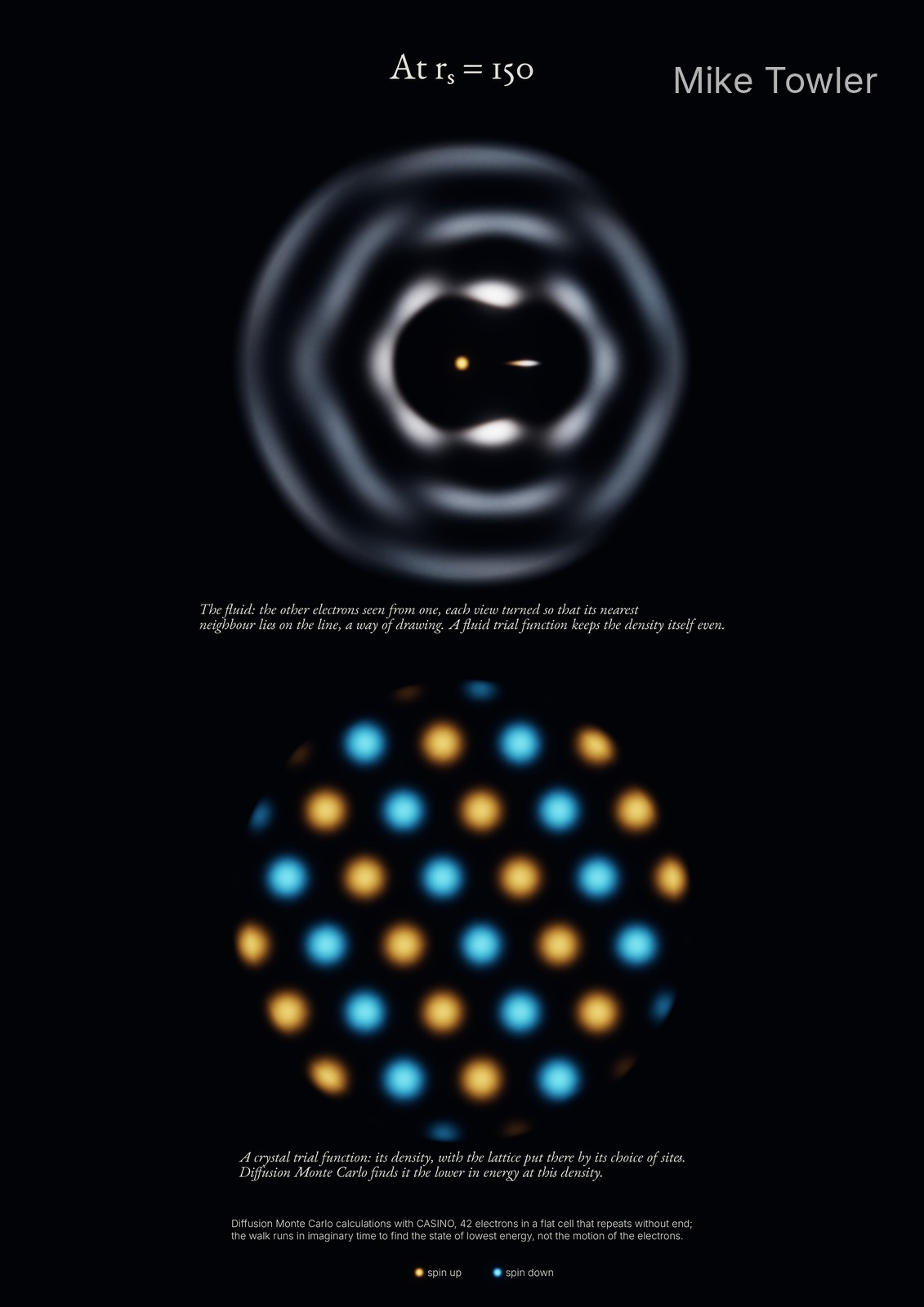
rings break into six peaks sixty degrees apart; then the density of a
crystal trial function, its lattice put there by its choice of sites, and a
small graph on which the crystal’s energy falls below the
fluid’s between rs = 30 and 60; the walk runs in
imaginary time to find the state of lowest energy and is not the motion of
the electrons.
Film by Mike Towler.
Two stills:
nine densities,
the density of the other electrons seen from one, each view turned, as a
way of drawing, so that its nearest neighbour lies on the line; and
two kinds of order
at rs = 150, the fluid’s turned pair density
above the crystal trial function’s density, whose lattice is put there
by its choice of sites; the walk runs in imaginary time and is not the
electrons’ motion.
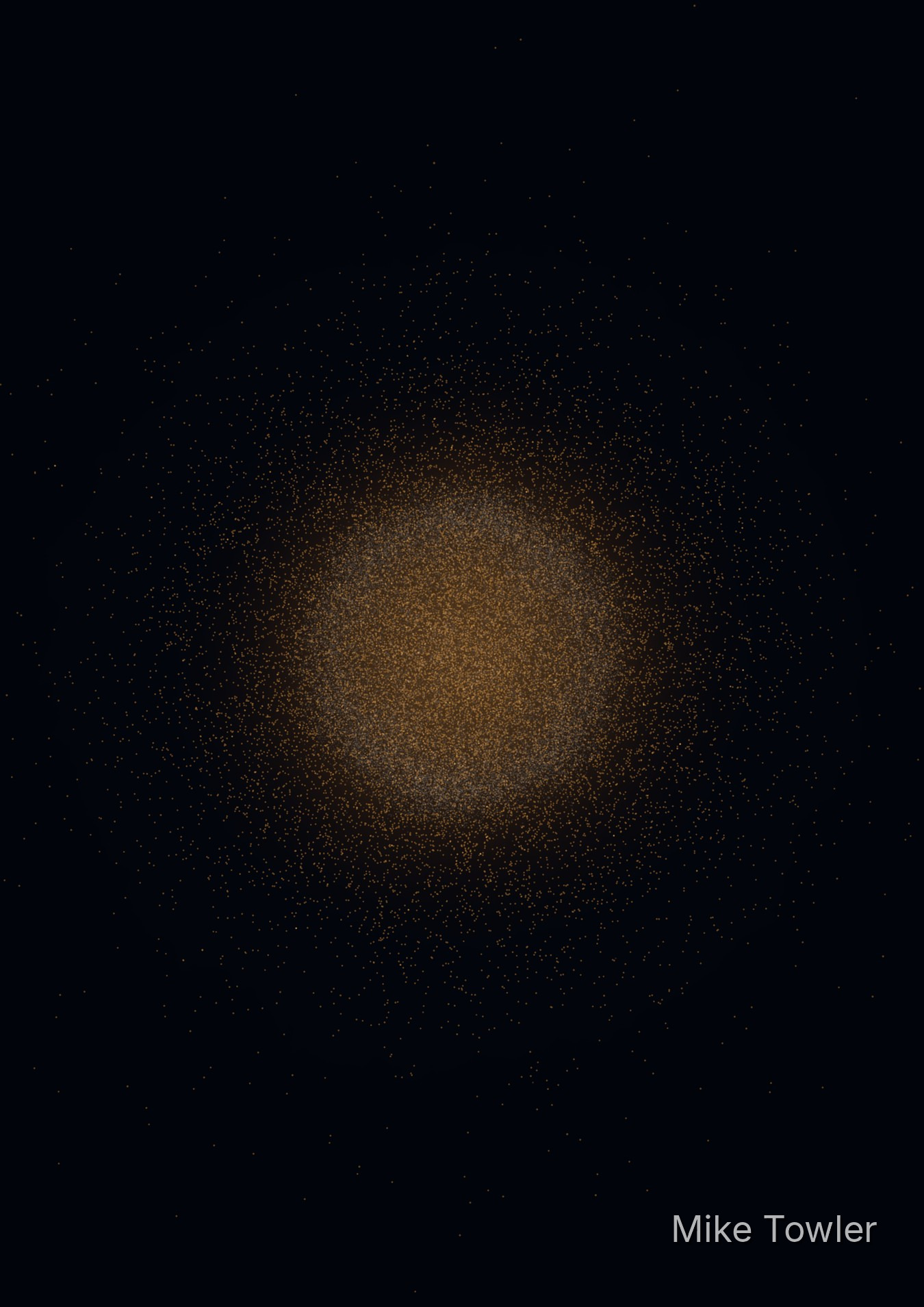
Octane
The loop on CASINO’s home page: the electrons of n-octane as the
walkers of a diffusion Monte Carlo calculation with CASINO v3.1.1055, every
electron of every walker a point of light, amber spin up and azure spin
down, about 180 walkers after each of 240 steps of 0.01 a.u., each frame
one step with the three before it fading behind, the last 30 steps laid
over the first 30 so that the loop has no seam; the walk runs in imaginary
time to find the molecule’s state of lowest energy and is not the
motion of the electrons.
Film by Mike Towler.
The same walk as a long exposure,
about 180 walkers at each of 241 steps on one picture; the walk runs in
imaginary time and is not the electrons’ motion.
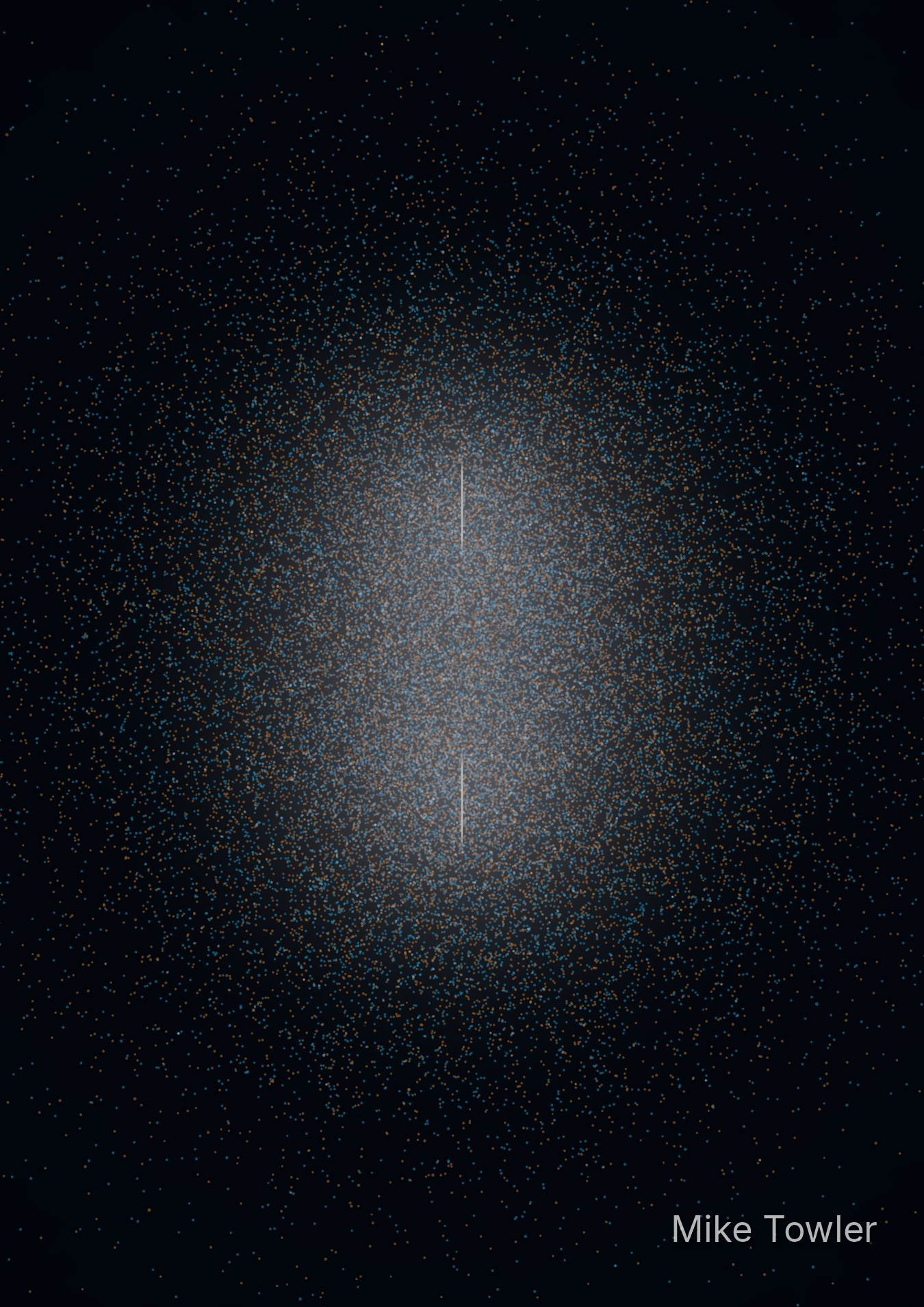
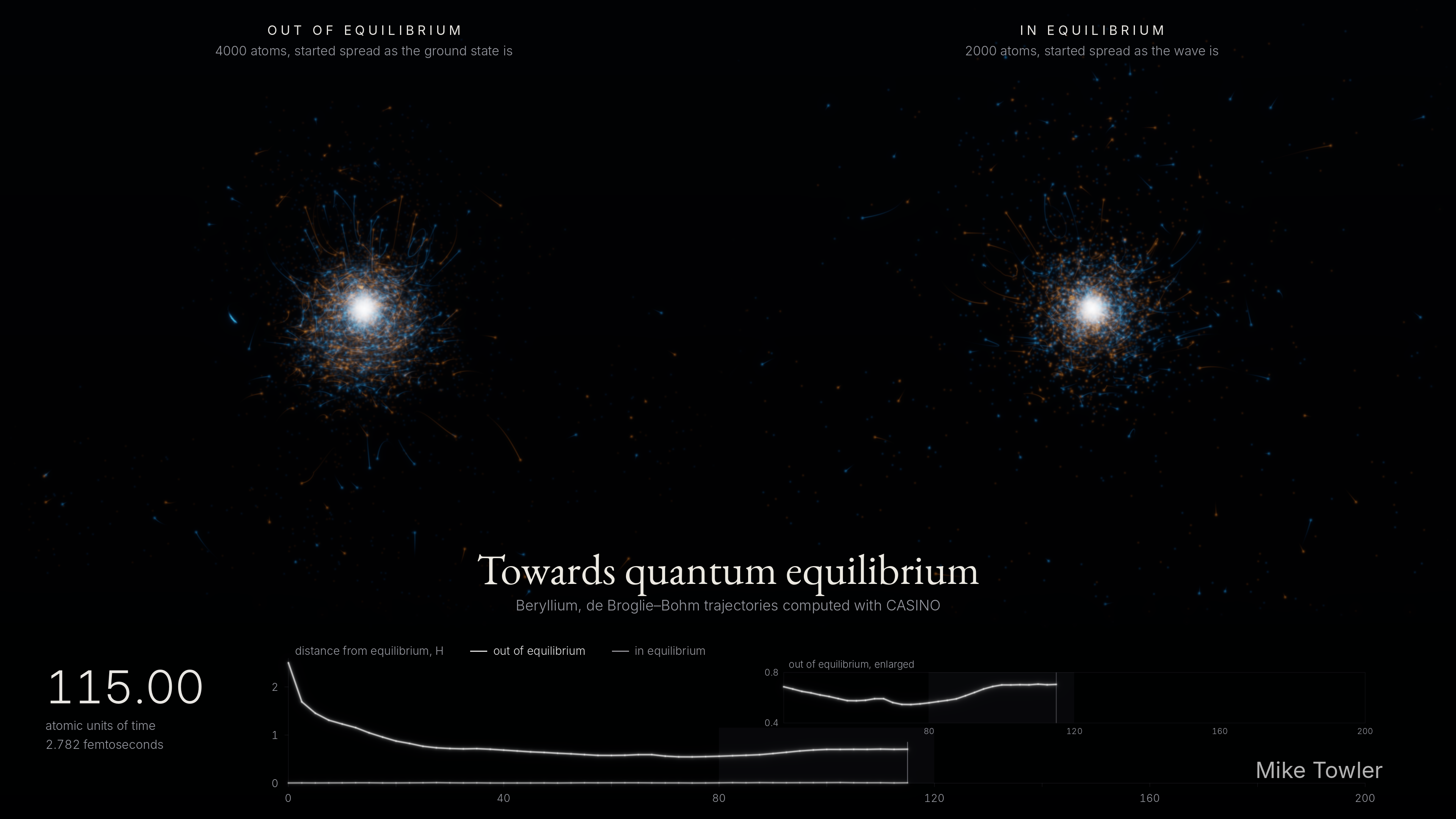
Towards quantum equilibrium: beryllium
The beryllium atom in a superposition of twelve of its states, its four
electrons moved in real time by the de Broglie–Bohm guidance
equation, computed with CASINO v3.1.851: on the left, 4000 atoms started
from the distribution of the ground state alone, out of equilibrium with
the wave; on the right, 2000 started in equilibrium; beneath, for both, H, a
coarse-grained measure of the distance from equilibrium: on the left it
falls overall, rises again between 80 and 120 atomic units of time, and is
still above zero at 200 (4.8 femtoseconds). Each point of light is a
computed position of one electron, amber spin up and blue spin down; the
trails join successive computed positions by straight segments.
Film by Mike Towler.
The poster,
the scene at 115 atomic units of time. The same scene can be turned in the
browser, below.
Simulations to turn in the browser
Caffeine’s walkers:
steps 401 to 660 of the same calculation as the first film, one walker in
twenty, on a page made by CASINO’s walkerfilm utility that plays in a
browser and turns under a finger; the walk runs in imaginary time to find
the molecule’s state of lowest energy and is not the electrons’
motion. One file of 17 MB.
Towards quantum equilibrium:
the beryllium scene of the last film, drawn live in the browser: drag to
turn the atoms, pinch or scroll to zoom, play and pause, with the same
explanation under “About this picture”. One file of 15 MB.