God, has it really been more than ten years since I last wrote anything here? When you step away from university life in Cambridge and retreat to a sixteenth-century mountain village in Tuscany, a decade can slip past with disconcerting ease. As far as CASINO was concerned, for quite a while I let things drift, occasionally merging a patch that Neil Drummond or Pablo López Ríos sent across, reading books I never had time to read, doing stuff, and watching the woodland slowly reclaim the agricultural terraces above the village.
Then, earlier this year, several things happened at once. First, in mid August I decided to publish CASINO 3.0, pending since 2012 while I finished the tedious DMC autostop thing. Then I decided to kick myself up the arse, pull together a serious computational laboratory of 64-core Threadripper workstations here in Tuscany, load them with all the software I could get my hands on, and give CASINO the top-to-bottom overhaul it had been owed for a decade. I don’t know why I did that, I just felt a strong urge one day. Must be a mission from God. Anyway, the immediate result of that two-month offensive is CASINO v3.2, shipping today for Halloween with 1345 patches, a completely rewritten 500-page manual, a browser-native version of the code, so many errors fixed you wouldn’t believe, and a large pile of new physics (see the Done and To Do page and the development log for the gory details). Second, and more importantly, this summer the old monastery building in Vallico Sotto began its second life.
Il Collegio and the Vallico Academy
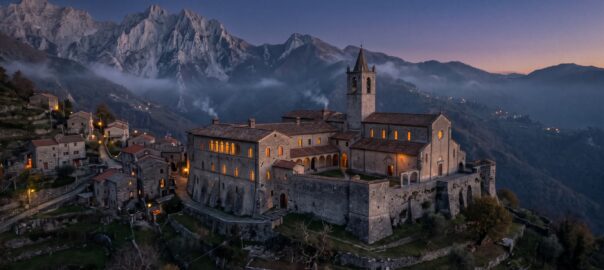
Anyone who came out to the Apuan Alps for our quantum Monte Carlo workshops or the CASINO summer schools between 2005 and 2017 will remember the building: Il Collegio, clinging to the hillside in Vallico Sotto (population roughly 800 in the 1920s, around 25 today). For a dozen years it served as the Towler Institute and the Apuan Alps Centre for Physics. This year, after a long refurbishment incoroprating the house of our dear neighbour Flora Calissi, it reopened quietly as the Vallico Academy.
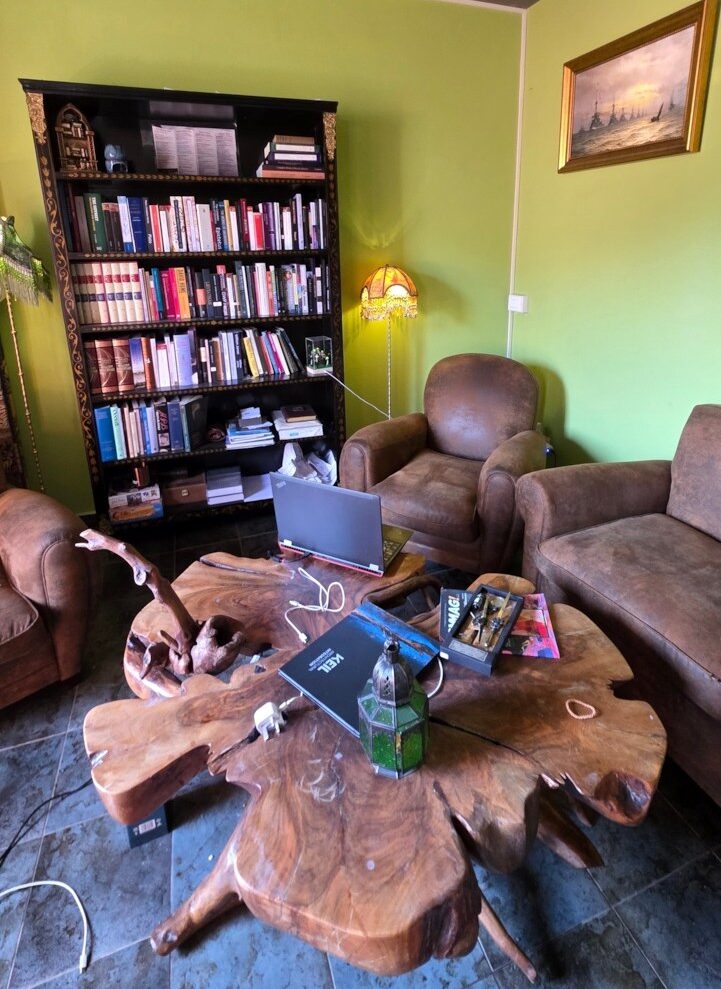
Modern university departments are marvellous machines for turning grant applications into incremental papers, but they are increasingly hostile places in which to think about anything large, slow or unfashionable. The Academy is an attempt to build the opposite sort of sanctuary, closer in spirit to Marsilio Ficino’s original Academy in the hills above Florence: a small residential place for long questions, serious conversation, independent work and the kind of thought that needs time. Physics remains at the heart of it, particularly electronic structure and the foundations of quantum mechanics, but the remit is deliberately wider. The library is growing around the things we actually argue about over dinner: physics, philosophy, consciousness, history, literature and art. One room houses the Classical Education Library, which began when we looked at the four-year Great Books syllabus of Thomas Aquinas College, covering everything from Plato and Plotinus to Faraday and Einstein, decided the list was too good to leave as a piece of paper, and bought the lot.
In the fullness of time there will be an 18th-century experimental laboratory where you build real physical things and test predictions without spending millions. Most modern physics requires a synchrotron because people ask boring standard-model questions. If you ask clever nonlinear, macroscopic, or foundational questions, you can build a breathtaking laboratory at Vallico for the price of a workstation or two.
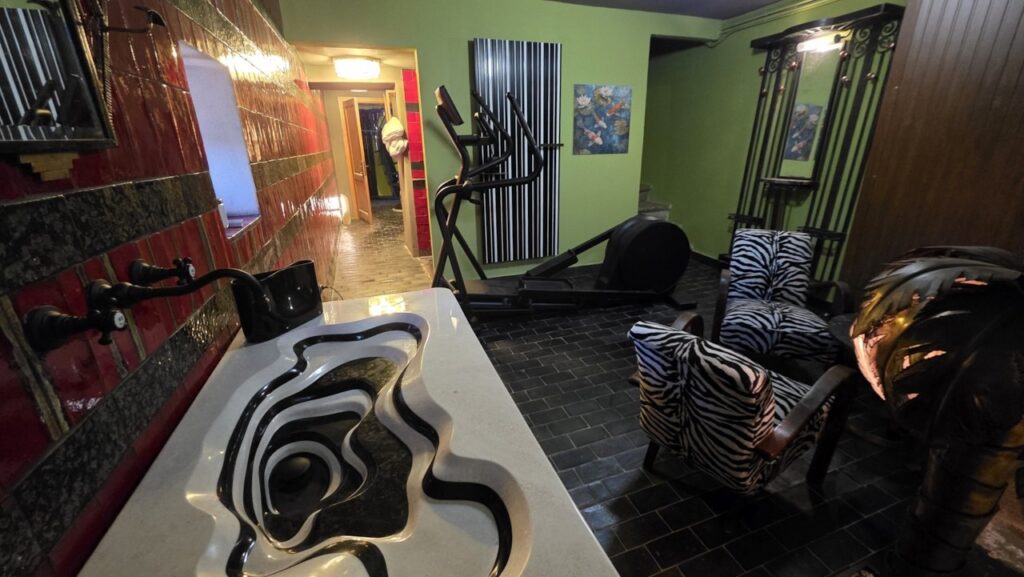
The house has one foundational rule, which is painted metaphorically over the door: “Speculation is allowed; pretending speculation is established fact is not.” And because twenty hours a day in front of a Linux terminal is bad for the soul and worse for the spine, there is room for the body as well as the mind, with places to train, recover and occasionally hit things. (A heavy bag in the cellar turns out to be a remarkably effective way of resolving differences of opinion with Referee 2, or with a Fortran compiler that has spent the afternoon lying to you.). I hate to say it, but there is also a beautiful sauna and spa.
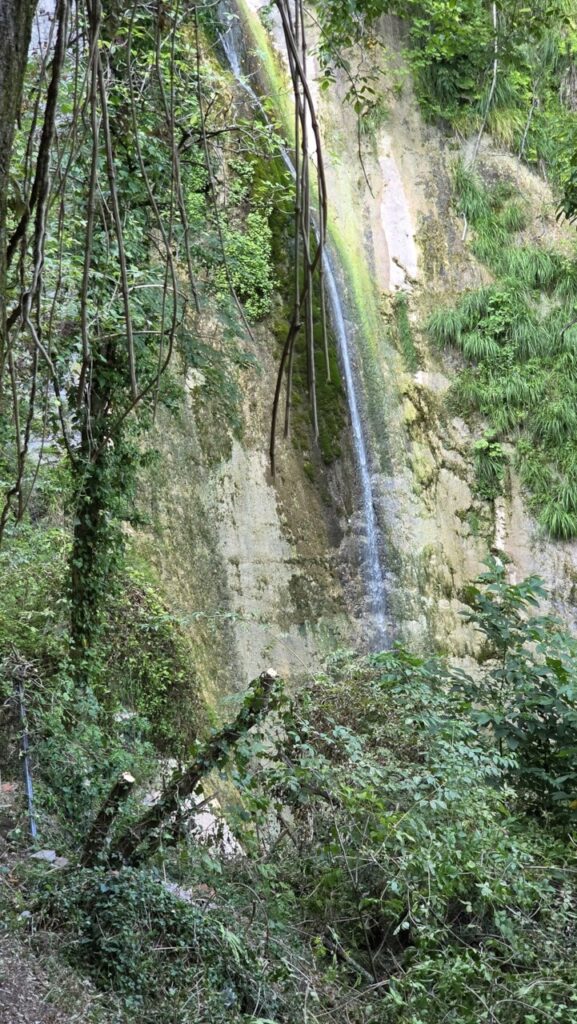
Above the village, on 8,300 square metres of south-facing terraces that the chestnut forest was taking back, we are establishing Vallico Farm as the working outdoor half of the same experiment, complete with an incoming herd of Peruvo-Tuscan alpacas and a trail down to the waterfall. From the outset, the Farm is designed as a social farm (agricoltura sociale): a place where my son Jamie, who has learning difficulties and started at the Steiner school in Florence this autumn, and others like him can live and work as full participants in a real enterprise, supported rather than segregated. None of this is a corporate foundation or a bureaucracy; it is simply what we are building in the village we love.
Series I: Five evenings in the church (Summer 2026)
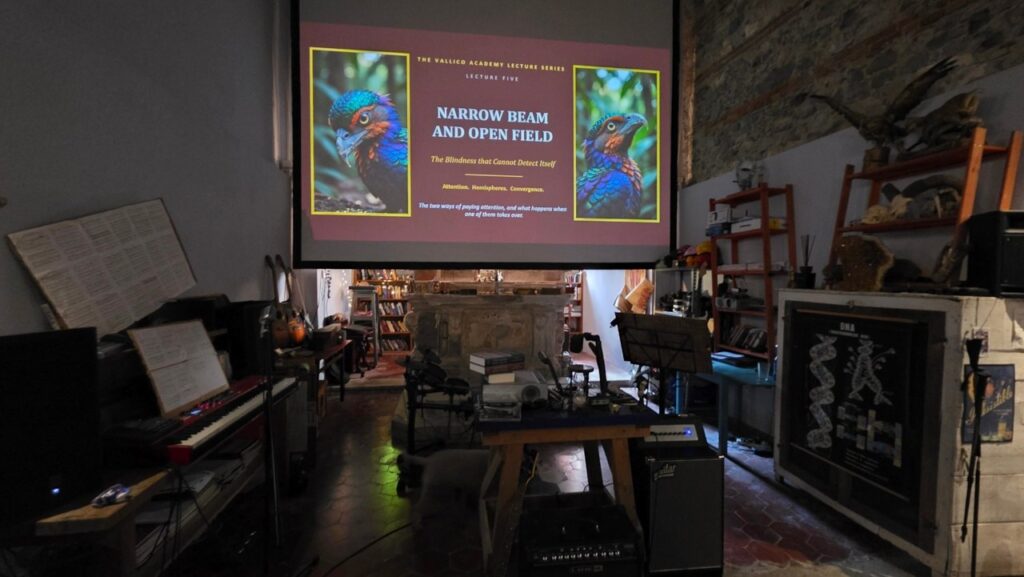
In the summer of 2026 our first small group of test guests arrived for the Academy’s unofficial opening. Because I had not given a lecture since leaving Cambridge ten years ago and wanted to see if I still remembered how, I gave five evening talks in the former church. The subjects were chosen to look completely unrelated on the first night, while circling a single unnamed question that only came into full view in the final talk:
- I. Richard Francis Burton. Explorer. Linguist. Scandal.
- II. Plotinus and Western Esotericism. Mystics. Heretics. Engineers.
- III. De Broglie, Bohm, and the Pilot Wave. Waves. Particles. Exile.
- IV. Local Brains, Universal Consciousness: Orchestrated Objective Reduction vs. the de Broglie–Bohm Panpsychist Cosmos.
- V. Narrow Beam and Open Field: The Blindness that Cannot Detect Itself.
The fourth lecture takes a speculative philosophical hypothesis, turns Chalmers’s “hard problem” of consciousness upside down, and then spends its final act ruthlessly auditing the physics objections against itself. The fifth brings the whole arc together through Iain McGilchrist’s account of the divided brain and the two modes of human attention: the narrow, grasping, instrumental beam that takes things apart to manipulate them, and the broad, open, relational field that sees the living whole. (I sent the slides and scripts to McGilchrist in August to thank him for the inspiration, expecting nothing, and received a wonderfully warm reply by return of post). The talks were not filmed, because a camera changes how people talk in a room, but all 210 pages of slides and 142 pages of full verbatim speaker scripts (some 76,600 words) are freely available on the Series I Lectures page. Lecture III is the bridge to what CASINO has been doing this autumn, which the companion post on pilot waves in CASINO takes up in detail. I’m currently preparing a paper “The inverted hard problem: filter theory, agency and the universal wave function” based on the lecture series, which will be my first foray in trying to publish in a philosophy journal (What are they even called? Hmmmm..)
Three foundational courses in the forge
Alongside the new research papers coming out of the Vallico cluster, I am writing three major lecture courses for the Academy:
- Diffusion Monte Carlo: the walk, the wall, and the residual. A complete mathematical and physical treatment of DMC written for someone who knows quantum mechanics and wants to understand what random walks in imaginary time are actually doing. Now in its fifth draft (193 pages of slides, a 60-page spoken commentary and seven mathematical appendix decks), it builds the stochastic calculus from scratch, proves the exact correspondence between DMC and Edward Nelson’s real-time stochastic mechanics, and analyses the three prices the method pays: equilibration, finite time step (where Wiener–Hopf renewal theory meets the three-dimensional Bessel process at a nodal wall), and the fixed-node kink.
- Basil Hiley’s algebraic quantum mechanics: the ideal, the bracket, and the bridge. Basil Hiley (1935–2025), David Bohm’s closest collaborator for thirty years and co-author of The Undivided Universe, was a friend and a memorable speaker at our 2010 Vallico conference. Most physicists have never read his forty-year programme deriving the Schrödinger, Pauli and Dirac equations from minimal left ideals of non-commutative phase-space and Clifford algebras, and those who try often bounce off the typographical errors in the original papers. This course (207 pages of slides and two appendices, backed by symbolic verification scripts and a 76-entry erratum register) reconstructs the entire edifice cleanly, repairs the general-β relativistic Dirac–Bohm quantum potential, and links Hiley’s Moyal moment hierarchy directly to weak values and the quantum geometric tensor.
- The new de Broglie–Bohm course. In 2009 I gave an eight-lecture graduate course on pilot-wave theory at the Cavendish Laboratory, which has lived ever since on this site’s de Broglie–Bohm page. It is now being rewritten from the ground up into a sixteen-lecture series in three movements: the core theory (Lectures 1 to 6), its relativistic, field-theoretic and cosmological edges (Lectures 7 to 12, with Lecture 12 devoted to CASINO, LOUIS, and real-time many-electron trajectories), and the historical and philosophical frontier beyond it (Lectures 13 to 15, preceded by a popular opening lecture, The return of pilot waves).
A note on the door
One practical postscript: while the lectures and papers are open to everyone online, the physical Academy at Vallico Sotto is not yet open to applications. We are still finishing the farm infrastructure and developing the residential fellowship programme, and for now guests are by invitation only. Oh hell, though, you can only ask.. When the alpacas are settled in their paddock and the doors are ready to open wider, you will read about it here.